Friday, May 15, 2015

O Mary, We Crown Thee...

-->

May crowing has always been a cherished practice at NDA.  This year, as other years, the privilege of doing the honors—crowning the statue of Mary and carrying the crown—have gone to the two students whose essays were chosen by the judges.  Since excerpts have been lifted from both essays, this blog is rather long.  However, reading it may lift your spirit to the Queen of the May.  Shannon Wilson crowned Mary’s statue, and Brittany White was her attendant. 

Shannon wrote:
“As I sat on my bed, reading the letter I wrote to myself at Sophomore Retreat, I realized what a big impact Mary has had on my own life.  In my letter, I wrote about how Mary had been the focus of our day. We reflected on how she has played such a pivotal role in the shaping of our school community as well as in our own lives. I expressed in my letter, a newfound love for the Mother of God… I found that praying to Mary could provide me with new possibilities to grow in my faith that I hadn’t yet explored in my relationship with the Father.
“So I began learning abut Mary, trying to understand how such a young girl could say yes to the most important question in existence. In this newfound relationship, I began trying to place myself in the shoes of 13-year-old Mary. I began reflecting on what my answer would be if God asked me to be mother to the savior. I quickly realized that I would not have had the same courage that Mary had. There is no way I would have been able to face the judgment from society. I would feel as though God was asking too much of me.  This reluctance challenged me. As I began reflecting on the life of Mary, I challenged myself to live a better life of faith. Mary quickly became my role model and I knew that if I could even trust God a fraction as much as Mary did, my life would completely change.
“…In preschool at Julie Learning Center, I vividly remember our May Crowning Ceremony. I didn’t really understand much about it, but I knew it was a big deal. I had the privilege of putting the crown on the strange statue’s head. Whatever I was doing was important because we all stood there in silence a little bit. I remember feeling this great deal of pride for being a part of such a special ceremony.
“Being able to crown Mary is such an honor for me in my last month as a senior. She has grown to be one of my biggest faith role models and I love that I am able to show her a bit of thanks for all she has done for me. I am honored to represent the Class of 2015 in the crowning of Mary, the foundation of our school.  My May Crowning experience is now coming full circle and ends my time with the Sisters of Notre Dame in the same beautiful way started: with the recognition of the majesty in the Blessed Mother.”
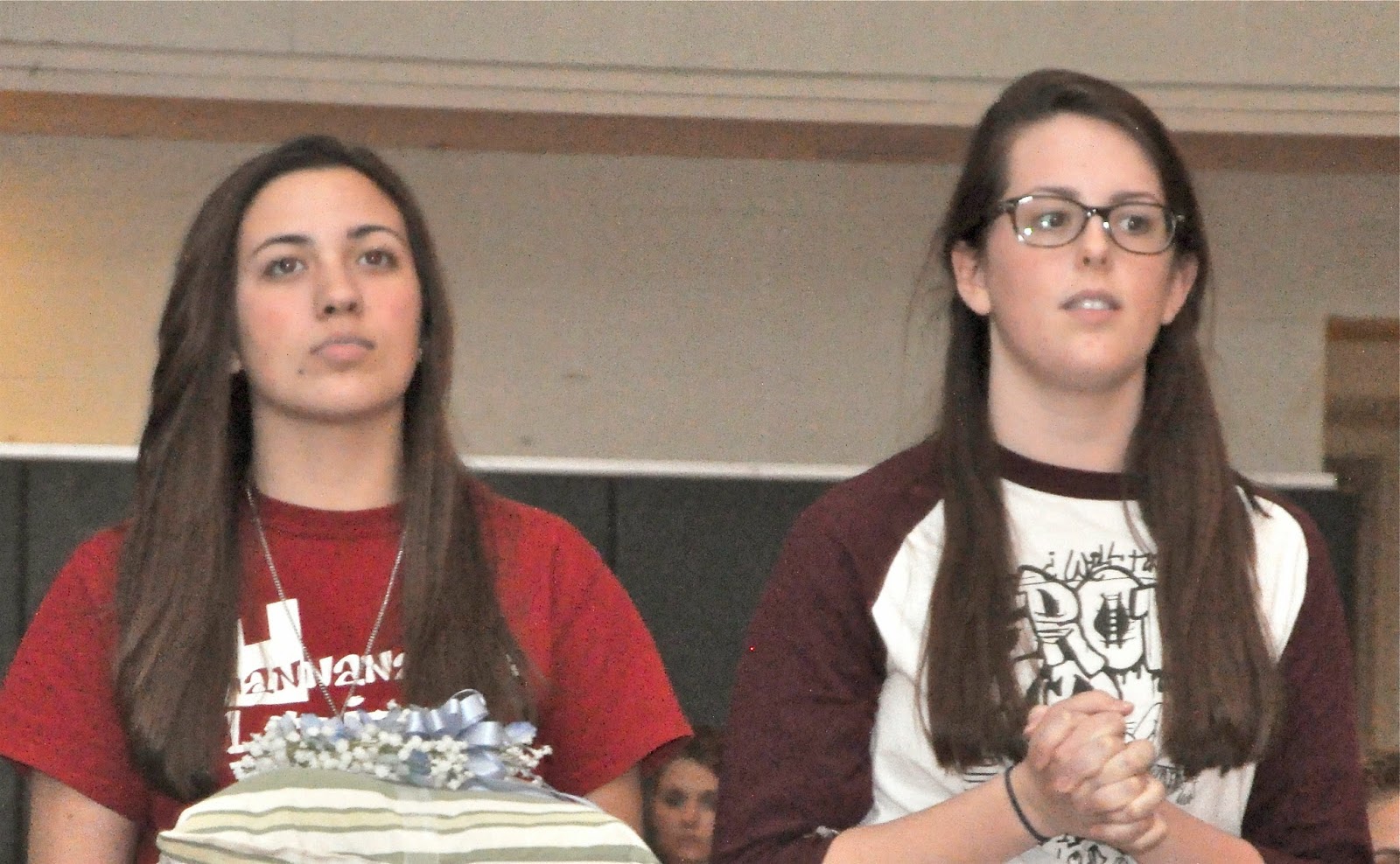


These are Brittany’s thoughts:
            “At fourteen years old, Mary, the Mother of God, was able to make a life altering decision which saved the world.  How amazing!  I can tell you with confidence that may girls who attend Notre Dame , including myself, desire to change the world in some way, whether it be through politics, research, or religion.  Personally I desire to change the world with my religion…  (Mary) didn’t know why God was calling on her for this task, but she did it and had so much faith in His plan.  ‘Behold, I am the handmaid of the Lord; be it done unto me according to thy word’  I can remember very few of the serious decisions that I had to make as a fourteen year old, yet nothing could’ve ever compared to the gravity of Mary’s yes to God.  Such a young girl with a great deal of faith!  She knew that God had a plan for her and she entrusted her well being to Him without a second thought.  That is what I desire, that trust, love, (and) commitment to God.  I want to be so faith filled and trusting in God that when I know He’s calling to me I’ll go and do for Him whatever He wants.  This school dedicated to Mary has made me realize the importance of Mary’s yes, and I can only hope to be so willing like she was.  Why is it that we are so afraid of how God wants to use us tin this World?  Do we fear that the road we’ll take is one we won’t like? 
            “…Mary helps me to see the role I play as a woman of faith, someone who isn’t afraid to trust in God or afraid to allow God into (her) daily life.”

Tuesday, April 14, 2015

1915 Dreams and Decisions


“Now Henrietta, sit still while we go through these choices.  I know you’re excited and so am I, but we must get down to business here.  Let’s see, the Course of Studies list they sent from Notre Dame Academy presents so many considerations.  First we must decide which program you’ll get into: the Scientific,  or General, or Commercial Program.  Your father thinks you should go into the Commercial, but I like the idea of the Scientific.  It’s college preparatory, you know, and wouldn’t it be wonderful if you would go to college.  You always talk about being a teacher, although your father would like for you to work your way into his business.  Your brother disappointed him by choosing the military.  But you, Henrietta, would be the first girl in the family on either side to go to college.  Let’s just examine what the four year requirements are for the Scientific Program and talk your father into it bye and bye.

“First year: Religion, English, Mathematics, Latin (good for nursing), Physical Training, and an elective of History, Science or Music.  You’re good in arithmetic, so the Mathematics shouldn’t give you any problem.
Second year: the same four required: English, etc. and the electives have language choices along with History, Biology (that would be good for nursing, too), and Music.  Too bad you can take only one elective.
Third year: The required now include Chemistry instead of Mathematics, and you can choose three electives!  The languages are Latin moved from the required, Spanish, French, German, Mathematics, History, and Music.  They certainly feel strongly about those last three.  I guess they hope all the girls will get Music at some point.
Fourth year: Oh my, Physics, dear.  They require Physics along with American History, Civics, and Physical Training.  They seem to be determined to keep you in shape.  Let’s see: the electives include Advanced Chemistry along with the languages and Music.  You may take three electives, but imagine taking two sciences at the same time.  Yes, I suppose you will want the Chemistry.   But, dear, Advanced along with Physics?  Well I’m sure you can, Henrietta, but you’ll have to work hard.

“Now to convince your father that this will be the best way for you to go.  He was so impressed when your cousin Lydia took the Commercial Program and then got a good job at the Big Four Rail Road office over on Central Ave. and Pearl St.  But we will work on him with all the good arguments we can come up with, and Henrietta, we’ll pray to Mother Mary who will certainly pull us through.  How wonderful to have a nurse in the family!”

Now Henrietta is fictional, but if you really want to know what the graduates of the Scientific Program (and the rest of the high school) really looked like, here they are.  No problem in seating their families at the ceremony.

Monday, March 16, 2015

Little Treasures Found

Memories, like fleeting birds, take wing.  The task: to retrieve and hold in heart-hands.


We have in the archives any number of treasures.  One that surfaced recently was the Mary Martha Adick collection that a thoughtful relative gave us.  In the container are photos and other memorabilia, but what really catches the imagination is a poem.  While the author is unknown, it may have been a very clever member of the class of 1928 (or was it by their very talented principal, Sr. M. Agnetis?). 
And here it is:
Dear Old Notre Dame
I want to wake up in the morning,
         God down old Fifth St. in the morning,
And hear my classmates say good-morning,
         At dear old Notre Dame.
I want to make some paper roses,
         To watch Miss Whitney strike new poses,
And see Anne Campbell touch her toes-es,
         At dear old Notre Dame.
Got to thinking of history,
         And of Chemistry too,
They were always a mystery,
         So was Cicero and O(h),
I want to ramble down thru the hallways,
         To meet my teachers in the hallways,
Their smiling faces greet me always,
         In dear old Notre Dame.

I want to meet the N.D. scholars
         To see our Hedges grab the dollars, 
And Babe and Jane forget their collars,
         And Roselyn play the Jazz.
And Margaret show her golden tresses,
         And Catherine strut her pretty dresses,
And Lou and Angela caresses
         The fiddle and saxophone.
Got to see Martha Adick,
         Dot and Anna Mae Hayes,
Irene Cahill and Thelma   
         With their taking ways and say,
I want to learn when Alma rises
         And Bunny carries off the prizes
And Mary Deye the class surprises
         At dear old Notre Dame

In comparing the names of the graduates of the Scientific (ahem; i.e. high school) class for 1928 with the names in the poem, one finds the names of all of the members of the class.


The photo is also of the members.  It is interesting to recall what these young women were about to face in the country in the not-too-distant future.  But for this pictured moment, life held sparkling promises and fond memories of “dear old Notre Dame”. 

Wednesday, February 11, 2015

Mary on the Move

Memories, like fleeting birds, take wing.  The task: to retrieve and hold in heart-hands.

The walls of Notre Dame Academy as well as the campus are graced with many statues of Mary.
One in particular is especially dear to this blogger although it stands almost in obscurity.  How like Mary in her lifetime!   You’re wondering where this statue is, perhaps.  If you have occasion to come into the door at the far eastern end of the building, you will see it almost tucked in the left corner next to the staircase.  Its colors seem a little faded, although her facial coloring is strong.   Even the photograph reveals the age of the statue—over 110 years.  Typical of the period in which the statue was created, Mary looks like a northern European with her fair hair (actually, maybe a bit British) instead of a young Jewish woman.  Come to think of it, blogger doesn’t recall ever seeing a statue of a Jewish Mary.

Next you might wonder why blogger seems to think this statue special in any way.  Early photos of the 1901 chapel on the former 5th Street campus show this statue of Mary to the right of the main altar with a statue of the Sacred Heart to the left where one would expect to see Mary.  Perhaps it was during the renovations of the chapel in 1939 that the Sacred Heart statue got its own pedestal at the left end of the sanctuary and a different statue of Mary in the usual spot to the left of the main altar.  (Confusing, no?)

We think that the original chapel statue was then placed on the second floor in the hallway at the west end of the school building near the bookstore.  (You know, it’s hard to think back 60+ years.)  When the academy moved to Hilton Drive the statue made its way to the far eastern end of the building, which takes us back to almost the beginning of this account.   Mary with us all the way!

Thursday, January 15, 2015

Treasures Secured

Memories, like fleeting birds, depart.  The task: to retrieve quickly and hold in the heart-hand.


Surely in 1901 the NDA community considered their new chapel built behind  the school building to be a great treasure.  New, beautiful in its décor—the white wooden altars, lovely statues, large stations in deep relief,  the stained glass windows,
and quite notably, a front wall above the altars, filled with murals painted, the story goes, by Sr. Maria Casimira and her team of Sister artists.  Sister’s work appeared on the ceiling also—four Evangelists done in oil on canvas, 36” in diameter, and, as far as blogger can determine, located at the four corners of the ceiling.  While some of the murals were lost in subsequent renovations, the murals directly above the side altars and the Evangelists on the ceiling were mercifully preserved.   Above the side altars: the Sacred Heart statue was on the left altar (not usual, as you may be aware) so the mural above it depicted Jesus, kneeling in prayer in the garden of Gethsemane; the right altar with its statue of Mary was below a depiction of the Annunciation.  It is not known if these murals as well as the ones removed earlier in the sanctuary apse were frescoes (water color paintings on wet plaster) or simple paintings.

Since the Evangelists were on canvas roundels (circles), they had been glued to the ceiling.  Upon being removed, they were stored and subsequently brought to Hilton Dr. in 1963.  They remained in general storage until the archives was organized.  Currently the paintings are among the most treasured of the holdings in the archives.  The archivist took them to the Cincinnati Art Museum a few years ago to see if the preservationist there thought they were worthy of restoring—they are.

One can determine which of the Evangelists is which by the symbol appearing next to each: Matthew, a winged man—the Gospel begins with a genealogy of Jesus; Mark, a lion—the Gospel begins with John the Baptist, a lion roaring in the desert; Luke, an ox—the Gospel begins with Zachary offering sacrifice in the temple; John, an eagle—flying so high it can look at the sun (this Gospel is very lofty).  There are many interpretations of the symbols (Wikipedia), but these may be the most common.


Efforts to find out any more about the supposed creator, Sr. Maria Casimira have proven fruitless.  We do know that she came from Germany in 1877 during the Kulturkampf (the SNDs left Germany rather than give up wearing the religious garb as required by law).  According to her obituary she was a very humble person who did not mention anything about her artistic endeavors in her short autobiography.  Oh Sister, how could you leave us in the dark about what must have been an arduous but satisfying accomplishment? The NDA archivist wants to have a few words with you when she meets you in eternity. 

Monday, December 15, 2014

In Case You Haven't Heard

So what kinds of displays are put into the display case in the foyer?  Here’s the current specimen. 
"Time to renew a warm spot for Christ who is born in us daily," it says.  So what's the tree about?  Well, it's an...
(the Latin identification for the Warm Spot tree belonging to the genus caring.(A little poetic liberty taken here.)
The tree limb has cards that demonstrate the actions that will provide a “warm spot” that the poster urges, to wit: “smiling at the unpleasant person,” “feeding the hungry person,” (the students have accomplished this recently with a 14,000 cans collected), “listening/talking to the lonely person,” and so on. 
The case also holds the traditional NDA Advent prayer which you may recognize
Have a blessed Advent, Reader, one filled with reminders of the Christ who is born in us daily.
                        And of course a very, very blessed Christmas!

Thursday, November 20, 2014

Symbols Signal Substance


We all see so many symbols everyday: a large shell designating an oil station; an oval with a skyline on it; skull and crossbones; a big boy image holding a sandwich; and so on.  Here at NDA we are surrounded by symbols, some intended to elevate our thoughts, some to educate, some to entertain.  Below are some of the symbols we see around here.

As you enter the building, you see the lily (signifying the purity of Mary’s dedication to God) on the large stone marker, and when you walk through the foyer, you see the same symbol in the pillar behind Mary’s statue (notice it next time).


In Alumnae Hall is the shield of the Sisters of Notre Dame abounding in symbols: the surmounting cross; the dove (Holy Spirit); the star (Mary) above the waves of life’s ocean; the eagle (closeness to God, but also signifying German origins); the lion rampant (the influence of the French St. Julie Billiart ); and the lily.


Down to chapel to view a plethora (to use a suddenly popular word) of symbols, we dip our fingers into the holy water fonts, and behold the symbols.  On one side of the doors is the dove; on the other side we see the Chi-Rho linked to the anchor (Christ, our anchor of hope) and the fish (from the Greek word Icthus—the acronym for the Greek words “Jesus Christ, Son of God, Savior”).  


The altarpiece has three repeated symbols: the legendary pelican feeding her young with her own blood (Christ feeding us in the Eucharist); the birds (the faithful) feeding on the grapes and wheat (again the Eucharist); the peacocks feeding from the cup (the everlasting life—peacocks—given the faithful in the Eucharist).
Of course, your quick eye would spot other symbols, but these are perhaps most noticeable.  Keep looking!