Tuesday, April 16, 2013

Word Magnate To Hotel Magnate, Come In


If you knew Sr. Mary Agnetis, you are aware that she was born with a golden tongue to say nothing of a golden pen.  One might also think she had more than a passing brush with the Blarney Stone.  Today blogger will fulfill a promise made months ago that you would get a little peek at her correspondence with Conrad Hilton.  Chosen for this entry is part of her very first letter to the storied magnate, March 1, 1955, and his response. 

My dear Mr. Hilton,

      How do you do, Mr. Hilton.  It’s nice seeing you personally in your own office in the Town House.  My name is Sister Mary Agnes [Sister’s nom de plume when writing to Hilton], a teacher of teenage girls in Covington, Kentucky.  I’ve met you on two different occasions, Mr. Hilton: the first time, on Monday, September 26, when you met your admirers with your kindly satisfied Hiltonian Smile from the cover of Newsweek—Texas to Instanbul, The World’s No. 1 host.  What a magnificent record behind that heartwarming title…  Mr. Hilton, Do you have time to reminisce a bit?  Do take the time.  It’s relaxing.  And God knows you need a little relaxation.  Remember the day you strode into the lobby of the Mobly Hotel in Cisco, Texas?  How men, haggard with strain were pounding on the reservation desk demanding rooms with none to be had?  How someone said you, ‘No use waiting around here, Mister, there just won’t be any room’?  You saw the problem, Mr. Hilton, found the solution and solved it admirably.”

Well, we can see where she was going with this, and perhaps he did too.  Sister went on for two plus more pages describing the situation/condition at Fifth Street.  Now for a glimpse at Hilton’s reply dated March 9, 1955.

Dear Sister Mary Agnes:

I received your very interesting letter of March 1st and I assure you that I did not look around for the wastebasket when I read your letter.  As a matter of fact, I have read it several times and I congratulate you on your talent.  I think that I would be willing to employ you, either as a salesman or a writer.

He went on to tell her that her request will be honored (no specifics, of course) but not at the moment.  He enumerated some of the building projects that he had done or was in the process of funding for other religious communities of women, besides assisting people across the world.  Not a day passed when he did not get a request for monetary assistance.  She was not to think of his letter as a refusal, but as indication of a delay.  In the end, Conrad Hilton responded to Agnesian charm with a very generous one third of the total price tag on the Hilton Drive construction of 1962-63.  Naming the driveway to the building is not only the least that the academy could have done, but stands as a metaphor—we couldn’t have gotten to the new building when we did without Conrad Hilton’s generosity.

It is to be noted that this correspondence was no momentary phase that lasted only as long as was necessary.  It endured for ten years and fills two large loose-leaf binders, one of the many treasures in Notre Dame Academy’s Archives.

Tuesday, March 12, 2013

Repair to the Attic


-->
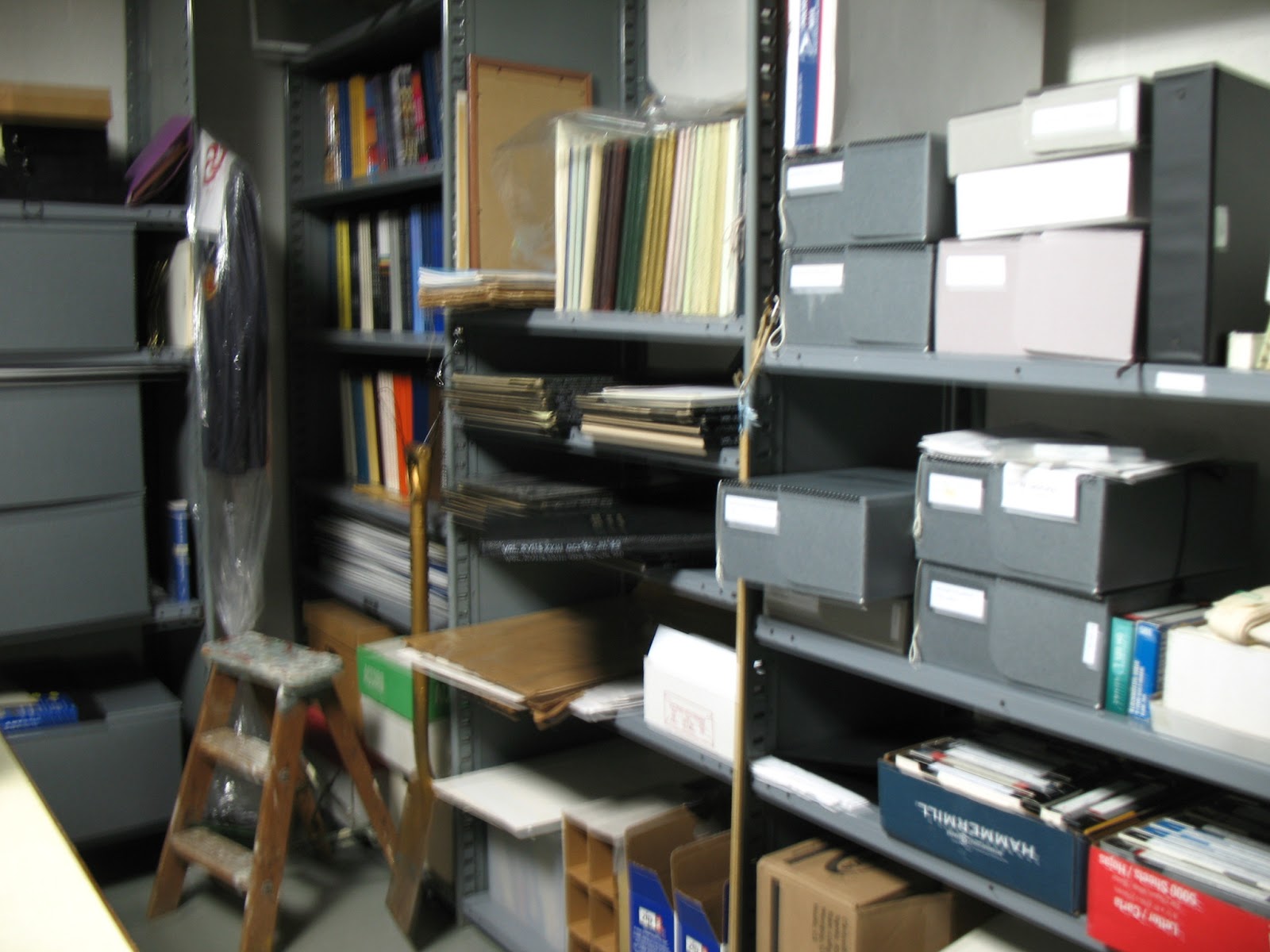
NDA archivist Sr. M. Dolores likes to say that she is the keeper of the attic, reflecting the idea that people keep old treasures, as well as things they don’t know what to do with but don’t want to toss, in their attics.  This problem is solved in an institution by establishing an archives.  NDA’s formal archives’ beginning dates to the summer of 2007 and currently contains over 600 artifacts and files.  What on earth does it contain?  Certainly all is on earth, especially the earth of 5th Street West and the earth of 1699 Hilton Dr..  Our most treasured items include the bound Gavel collection dating from 1926 to 1954; a diploma from 1918; 34” roundels—round paintings—of the Evangelists from the ceiling of the old academy chapel before it was renovated; a collection of class rings (see blog entry of Dec. 5, 2012); the correspondence between Sr. M. Agnetis and Conrad Hilton (over 70 letters and cards written between 1952 and 1965); plus many more.

The photos you see give an idea of how large the collection is (you’re seeing only about a third of it) and a little of the variety.  The first photo is of the oldest diploma we have; the second shows the publications collection and the boxes on the left containing the old uniforms; the third is of the documents collection in boxes with category markings.  Interesting stuff, interesting work preceded by many years of careful safe-keeping of these items by such people as Sr. M. Agnetis, Sr. M. Jeaneen, and several alumnae and development directors.  The task in 2007 was to collect, sort, arrange, and contain the critical mass.  Today the work of collecting goes on with the help of Alumnae and Advancement folks, graduates who want to see their treasures valued and in safe keeping, and others who want to lend a hand.  Within the past year we received from Barry Aldemeyer the “Multiple Listing Service Report” from the 1950s stating the value of the 5th Street and Montgomery Street properties.  This proved to be a good companion piece to the Complete Appraisal Report, Land and Building Construction from the MacConnell & Co. Appraisal Engineers, a document that suddenly surfaced right here at home.  The Muses are still with us.

If the gracious reader is an alum of this venerable institution and feels inclined to entrust treasures from her years at Notre Dame to us, the archivist will receive them with gratitude and respect. 

Oops!  The last blog spot was no cliff hanger, but just in case you are of the younger set:  photo #1 is Sr. M. Rachel (Marlene); photo #2--Sr. M. Virginia Ann (now in Paradise); photo #3--Sr. M. Ethel (Lynn); photo #4--Sr. M. Paul Ann; photo #5--Sr. M. Lynette; photo #6--Sr. M. Dolores (Padraic).  Now you know!

Thursday, February 21, 2013

Not (much) the Worse for Wear

Currently there are five Sisters of Notre Dame at Notre Dame Academy in either faculty or staff.  All five are alums of this esteemed institution, carrying on the legacy left by so many SNDs who preceded them or who worked with them.  There are six photos in this blog spot, five of the current SNDs and one who sort of graduated three times from NDA and finally moved to Paradise.  You will probably be able to identify each (they “haven’t changed a bit”), so here they are in random order.  In a few days blogger will break the news and identify them, but no surprises are guaranteed.


Friday, January 25, 2013

Long Live Home Economics Class!


-->
It is difficult to know who began the  duotang binder entitled "Memories of Home Economics Class." It contains  photos from 1931 to 1958 related to home economics (called variously in our records dressmaking, cooking, home-making or home economics). There were a number of teachers who could have contributed during those years. The first recorded in the Sisters' Annals was a Mrs. Dorothy Colburn, followed by Sr. Mary Richard.  Though Mrs. Colburn left after a few years, she seems to have returned to the scene in 1933, and with her appeared Miss Terlau who remained after Mrs. C. left the following year.  However, Miss T. is last mentioned in 1935.  Her departure brought Sr. M. Mirella to the home ec. lab teaching cooking.  In 1936, Sister was joined in the dressmaking endeavor by Miss Virginia Ehrenfels. Was dressmaking a particular challenge?  Mrs J. F. Schulte appeared as the new dressmaking teacher in the record in 1937 while Sr. M. Mirella hung in with cooking and sewing.   Mrs. Schulte left in June of ’38 and was followed in the next school year by Sr. M. Verda, whom some readers will remember. In her first year teaching, having graduated from the academy herself in 1934, Sr. M. Verda taught the sewing end of Home Ec. while Sr. M. Mirella held down the cooking.  This arrangement lasted until the fall of 1945 at which time the latter left the academy for a few years and was replaced by Sr. M. Annata, perhaps another familiar name.  The two Sisters worked in the department teaching home-making, cooking and sewing for several years.  Sr. M. Verda served as chairperson of the department until the spring of 1994 at which time she retired.  Sr. M. Annata had retired several years prior to '94.

It’s impossible to know now what happened to the lay women who taught in the home economics department, but the Misses could have left to get married—a more than probable reason in the 1930s—while one imagines that Mrs. Colburn and Mrs. Schulte were widows who may have retired from the teaching scene.

The evidence for the time period for the binder is the years handily noted for several photos—the first 1931 and the last 1958.  The photos, many large, fill about 40 pages and show students at work or modeling their products.  There are several photos that give a good idea of what the labs at 5th Street looked like, fairly spacious with equipment that was standard at the time. 

All in all, blogger considers the artifact quite a treasure from an often overlooked department, certainly so in today’s high schools.  Lucky the school that has a flourishing home ec. program where students can learn the art of graceful survival in a world of pre-made everything.  NDA still has vestiges of the classical home economics department in its textile arts class.  Long live “the art of graceful survival in a world of pre-made everything.”

Wednesday, December 5, 2012

The belles have rings!


Memories like birds--fleeting.  "Catch us if you can!"


SCHOOL RING OR CLASS RING?

That is the question.  Blogger always assumed that the ring students received back in the mid ‘50s was the school ring.  When what to her wondering eyes should appear but rings and photos of rings from earlier years.  There was some reason to think that the ring of the ‘50s was the traditional ring because it lasted far into the ‘80s and maybe beyond (if only memory were sharper!).  Surely it was not changed in all those years given its history.  Wrong!  It did not have the history blogger assumed it had.   By 1949 the ring had changed at least four times since the early 1920s.  The first two rings above are easily identified as to year; the third ring is dated on the sides 1929, and the fourth, 1939. (It is not known when the high school inaugurated a class or school ring.)  Time marches on and so do tastes and interests.  Around 1990 the company selling rings was offering side panels that indicated the students’ athletic and/or club interests as well as well as ideas for new designs for the top of the ring.  After all, NDA’s design was old after nearly 40 years.  The ring began a new series of changes in the years that followed until a few years ago when a new version of the “old” ring was devised.
The variety and the spacing in years of new styles makes the question that opened this blog a pertinent one.  If individual classes could go to a new style of ring, did it become a class ring rather than one that easily identified the school of the wearer, regardless of year?  If you are an alum, how do you think of your ring?  Is it close to or identical to one you see below?
So here they are, the rings or photos of rings the archive possesses.  Some of the photos are blurry because of camera limitations, but are clear enough to demonstrate changes and give some sense of the ring’s appearance. 

Any addition to the ring collection will find a welcoming home in the school archives, by the way, regardless of year.  Who knows how the NDA ring history will expand!  If anyone knows of a NDA ring earlier than 1921, or any other interesting bit of history, be sure to let us know: giblind@ndapandas.org.

1949


Don't forget to let us know if you know more than we do about the NDA school/class rings!


Friday, November 16, 2012

Memories like birds--fleeting.  "Catch us if you can."

The Fashion Show Goes On


Moving beyond the early 1930s we come next to a modification of the winter uniform, i.e. a sort of shirt dress of any reasonable pattern, short sleeved, but now adorned with white starched collar and cuffs.  The exact year of adoption of this uniform is not known by blogger, but maybe an alum would be able to enlighten her.  The photos of the late ‘30s and early ‘40s do show this somewhat relaxed style, however.  The white collar and cuffs were “in” until 1954 when the navy blue jumper elbowed it out (gradually).  This was worn over a round-collared blouse: probably not the most happily worn, but enduring until the move from Fifth Street in 1963.

Ah, the move from Fifth Street—what a great and earth altering (literally) event.  This certainly called for an equally elevated style of dress (Hilton Drive is at a higher topographical elevation).  Indeed, a new look in building and grounds required an equally “spiffy” new look in garb satisfied by the dark gray skirt and dress jacket.  Oh how they were loved…by very few.  And so that style lasted a very few years, relatively speaking. By the late ‘60s it had already experienced a happy demise. 


 Do read on to the next chapter of this material evolution.